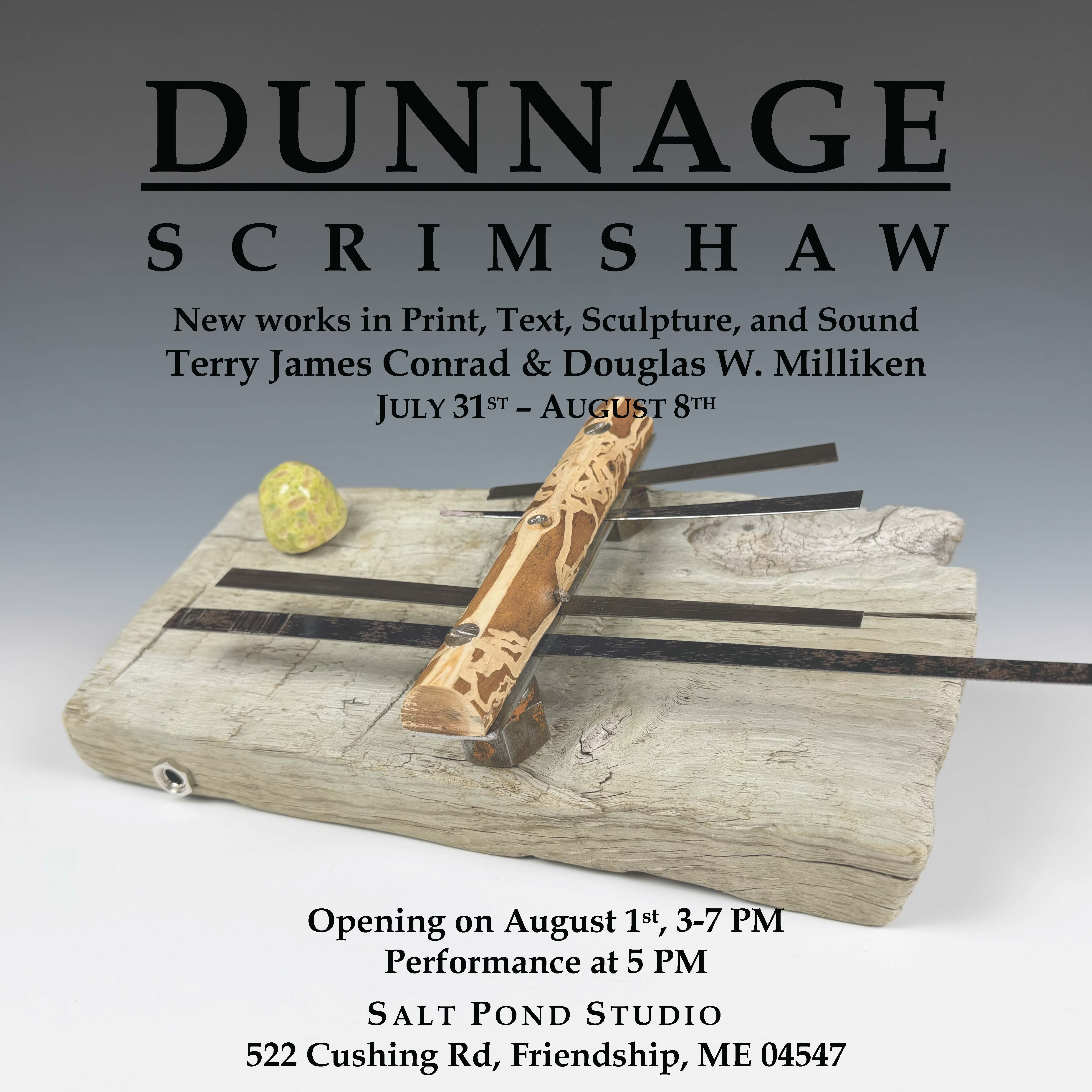
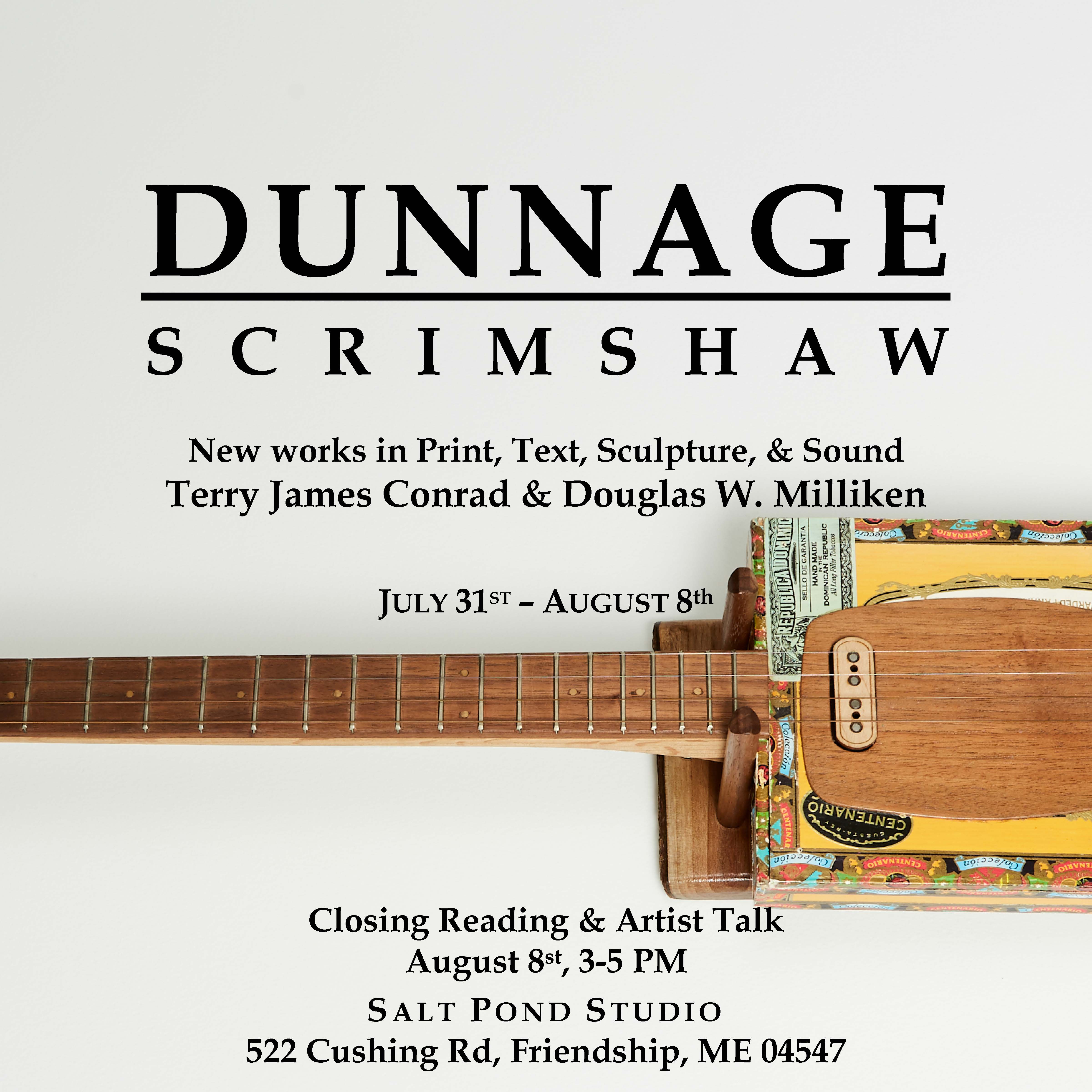
This past winter, my old college friend Terry reached out to me about a potential collaboration. What started off as vague inquiry into what might happen when our two brains pointed their attention on Terry’s hand-built instruments—some of them traditional (guitar, ukulele) and others overwhelmingly unique (see below)—quickly proved to be fertile ground for something distinct and open-ended and (at least for us) really damn exciting. Which is how we became Dunnage.
To state it formally:
Dunnage is the experimental sound project of artist/educator Terry James Conrad and writer/producer Douglas W. Milliken. Combining a mutual interest in collage, salvaged materials, and the fissures between the natural and industrial worlds, Conrad and Milliken use unique hand-built instruments, electronic interventions, found objects, and field recordings to create sonic spaces that are at once familiar and disarming.
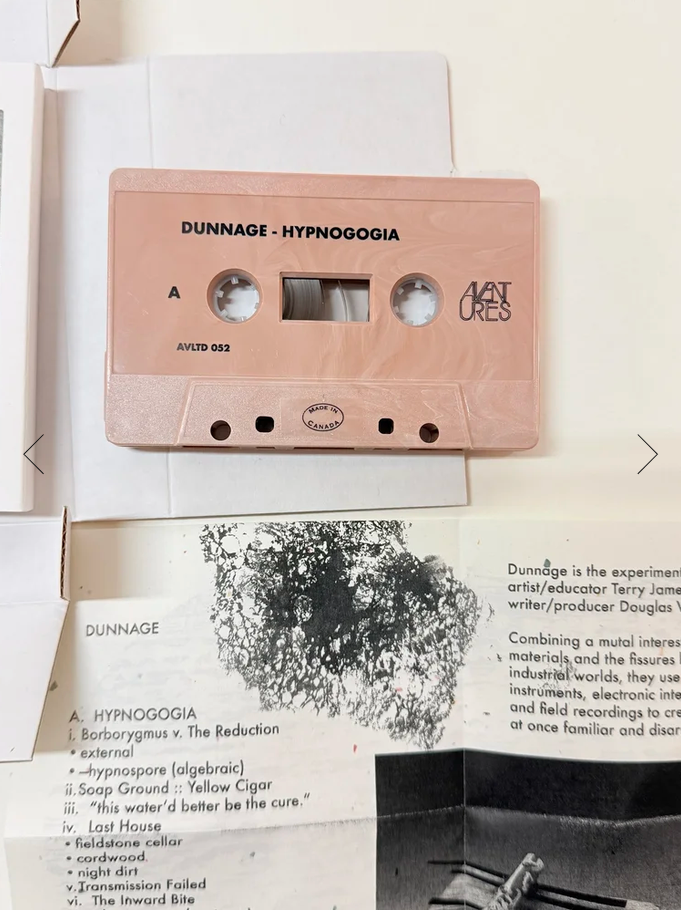
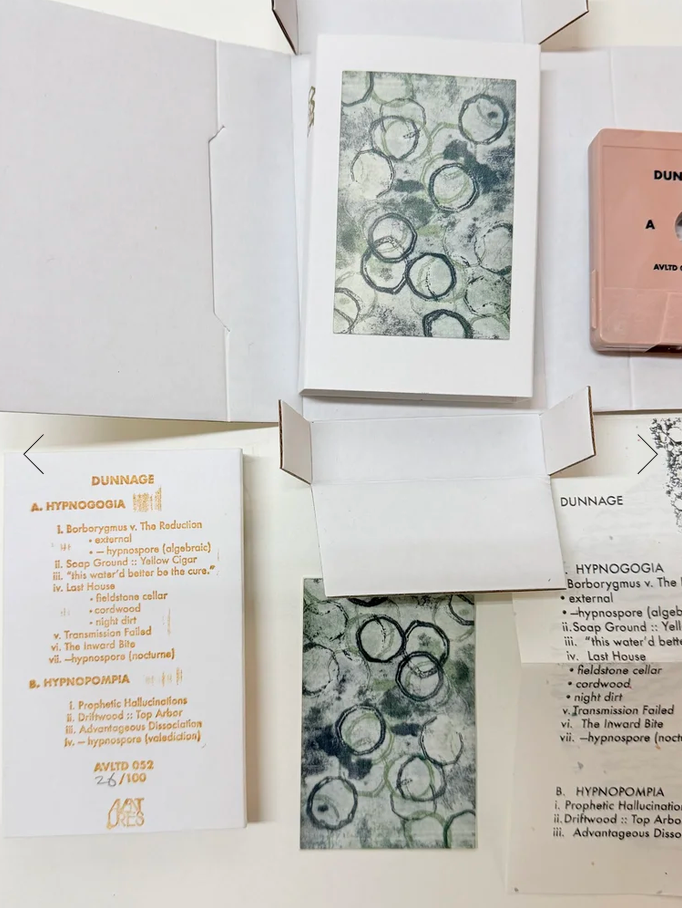
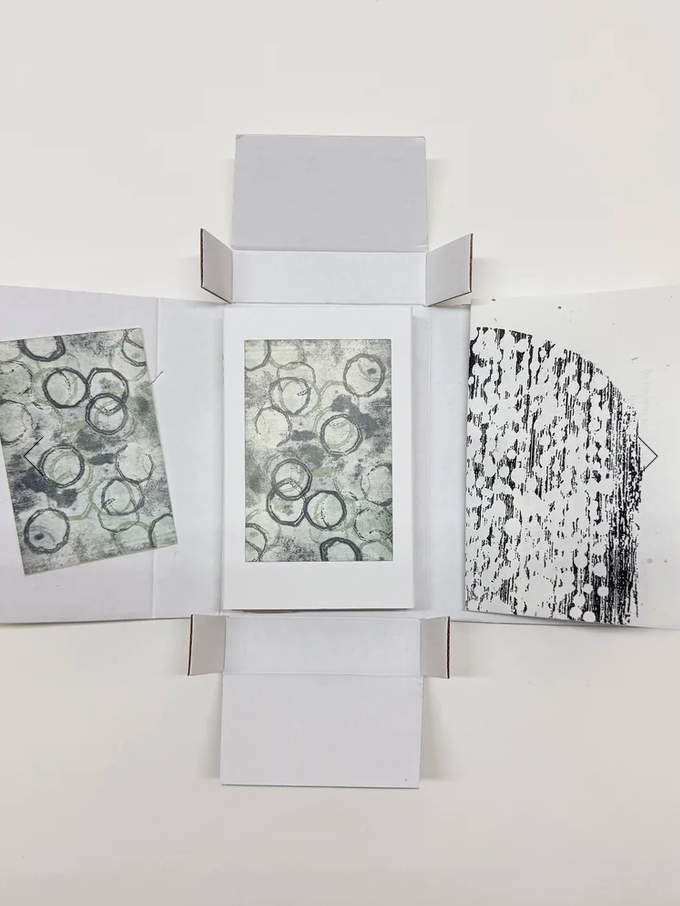
This week sees the release of our first album, Hypnogogia/Hypnopompia, released by micro-press-and-label Aventures LTD. As a physical good, the album exists as a limited-run cassette hand-packaged with Terry’s original artwork. For those who are analog-incapable or format-agnostic, the record is also available on Spotify and iTunes, with many other streaming services and Bandcamp due to carry it in the coming days.
Also this week is the opening of our show Dunnage :: Scrimshaw. Again, to state it formally:
Salt Pond Studio in Friendship, Maine, presents Dunnage :: Scrimshaw – sculpture, text, print media, and sound by author and musician Douglas W. Milliken (Saco, Maine) and artist, educator, and musician Terry James Conrad (Round Lake, New York). Embracing limitations with an emphasis on slowness as a virtue, the one-week show opens on August 1st with a combined literary/musical performance by Milliken and Conrad and closes August 8th with a reading by Milliken from his most recent book, Any Less You, and a talk on ocean microbiology by Conrad. Books, recordings, musical instruments (both traditional and unique), and limited-edition prints will be on view and available for purchase.
For those of you in the mid-coast area, we’d be delighted to see you at either or both events. The opening event is 3-7 PM on Saturday, August 1st, with our performance at 5 PM. The closing event is from 3-5 PM on Saturday, August 8th. Salt Pond Studio is open 12-5 PM, Thursday through Sunday and is located at 522 Cushing Rd, Friendship, ME 04547.For a sample of the more readerly aspect of our performance, consider “Parachute,” a vignette included in a recent issue of Invisible Cities.
Thank you for reading/listening/paying attention. I hope y’all are hanging in there. Perhaps I’ll see you soon.
Good morning, friends. I have fed the cats, taken my monthly shower (and daily meds), and am ready to share with you some recent developments. I’ll try to keep this quick.
Firstly, there are two new publications out there who are kind enough to include my work. The first is the Forge, who have published several of my stories over the years and have been hugely supportive of my work. This time around is a flash fiction piece called “All of Us”—a finalist for their annual short story award—but if you dig through their archive, you can also read “Perfect Water Aglow” and “Mascara,” which each include interviews with their founding editor. The second publication is the anthology Best Small Fictions 2025, which includes my micro fiction “Pristine” (originally published in Notch). It was an honor to be recognized by each of these publications. I hope you enjoy reading the stories as much as I enjoyed writing them.
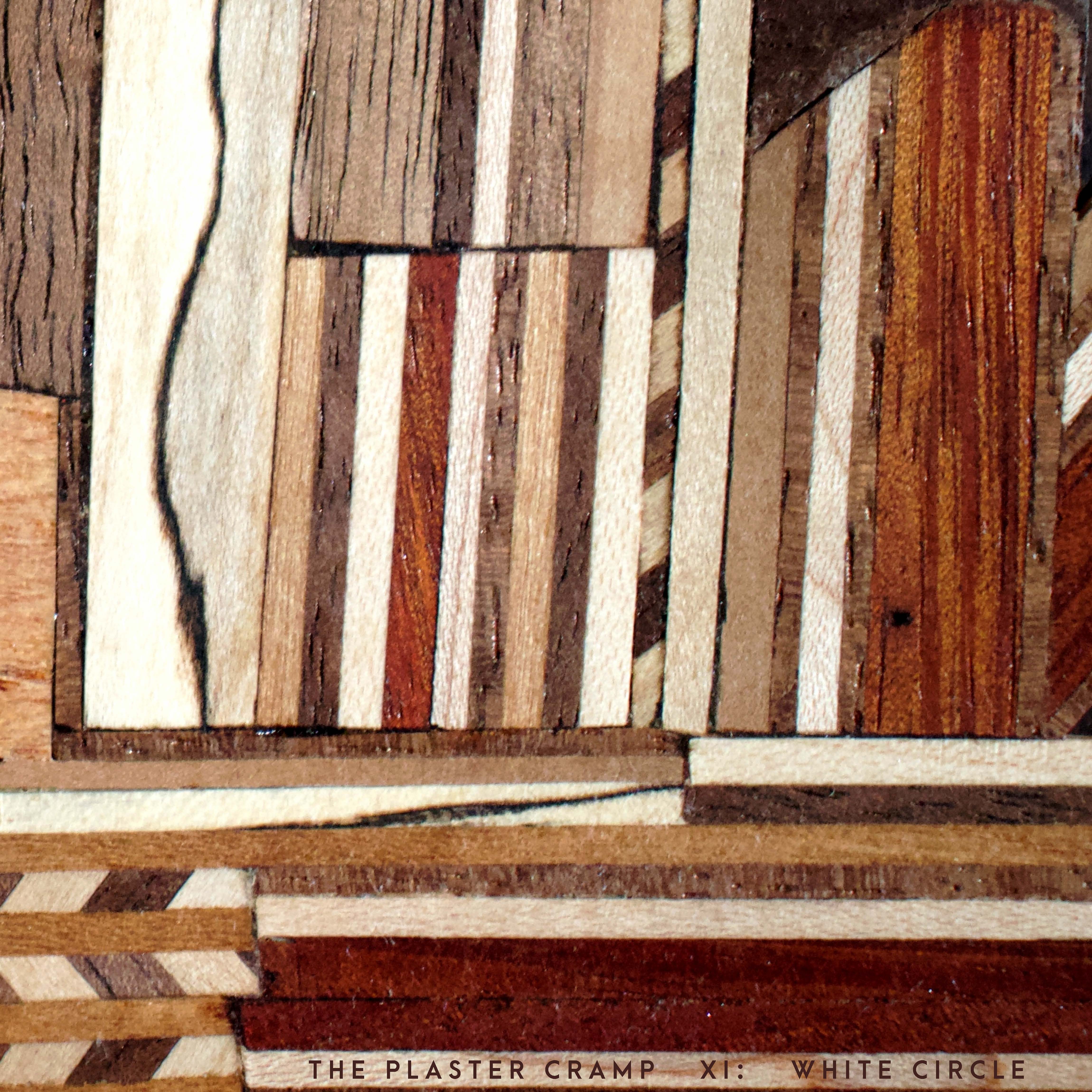
Secondly, in just a few weeks, a new Plaster Cramp EP will land. XI: White Circleis a continuation/shadow companion to last year’s X: Ultramarine, containing alternate arrangements of the forebear’s songs as well as a pair of brand-new tunes. The artwork for the album is a detail from a small sculpture by Terry Conrad, an old college friend and a phenomenal artist in his own right. Terry and I will be sharing more collaborative work soon, but until then, I hope you take a peek at White Circle’s lead single “Your Foolish Skin” and let us know what you think. It’s a digital-only release set to go live on numerous online shops and streaming services on March 26th, but you can pre-order the album on Bandcamp orpre-save on Spotify now and receive notice the moment the full EP becomes available.
Thirdly, on March 12th, my partner Genevieve and I will each be sharing work at the Food Collider event at Pizza by Alex in Biddeford. Doors are at 5PM with readings/performances starting at 6 PM. For more information and tickets, click here.
Fourthly, my long-form interview on Scott Sell’s Random Rules radio show has been archived and available for streaming.
And finally: over the years, many people have asked how best to purchase my books, and I’ve almost always reverted to useless shyness, garbling something vague and unhelpful. It was recently made clear to me, though, that my reticence to say “buy this here” was helping exactly no one. The truth is, there is no single simple answer because there is no single type of publisher I work with, which can get confusing. So let me make this easy. For my more traditionally published works, buy through Bookshop.org, which has the best profit sharing for me, the publisher, and independent bookshops. For more subversive work, buy directly from Publication Studios, as they are the ones who most often indulge my weirder impulses. For self-published reprints of White Horses and The Opposite of Prayer, buy directly from Blurb. You can also request my books through your local library. But if you can help it at all, do not buy from Amazon. I hope this is helpful, and if you have any questions, please don’t hesitate to ask.
If you’ve made it this far, you’re a champ, and I thank you. The world is especially terrifying right now without any signs that it’ll likely soon abate, so be kind to one another, look out for one another, and with inner-fortitude and the strength of community, we’ll survive this shit show.
Hello friends. My plan had been to send out a single mid-fall omnibus update about recent goings-on, but things began to pile up, some of which are time-sensitive. I will do my best to keep this quick.
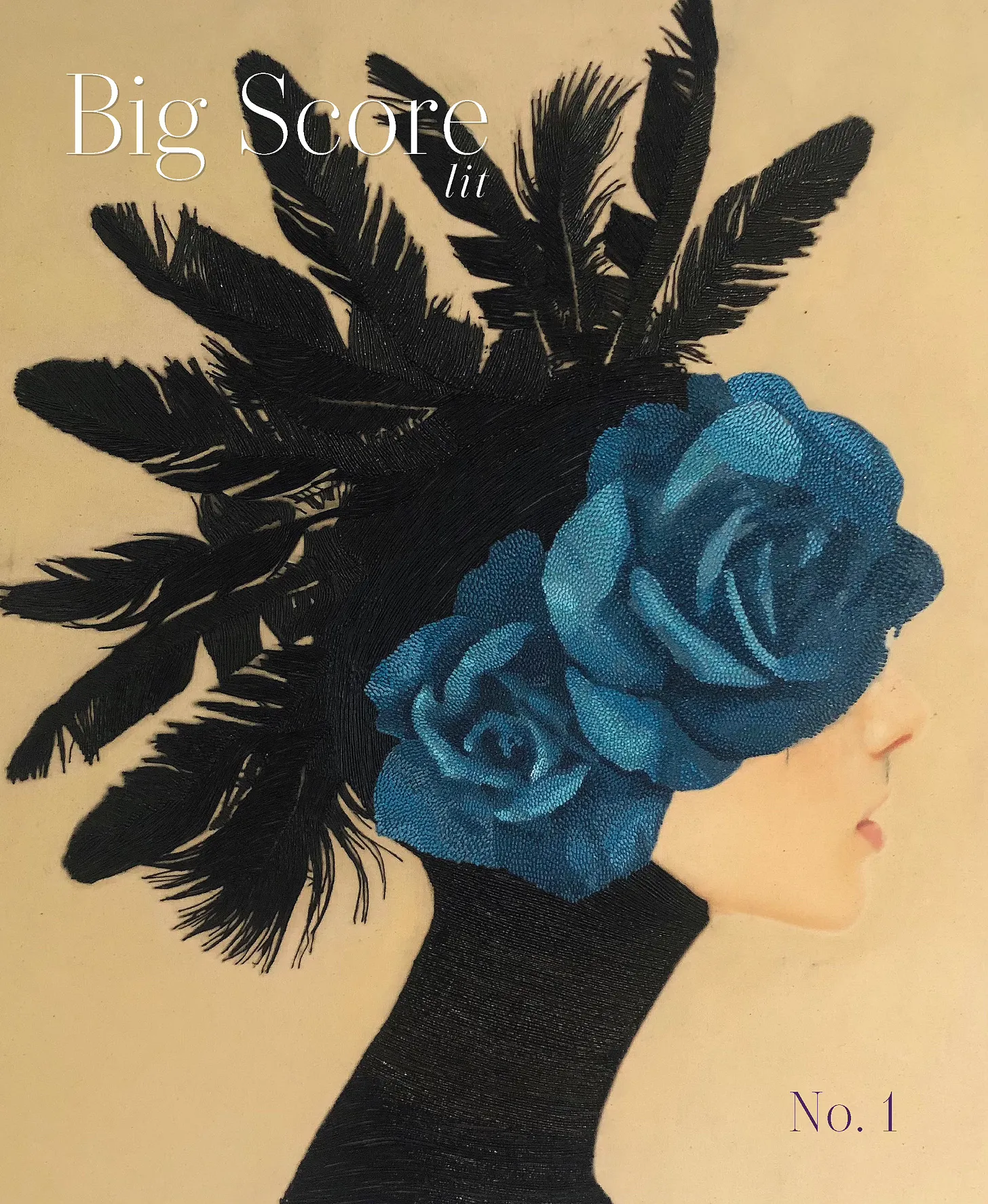
On Sunday, October 12th, there’ll be a release party for the debut issue of Big Score (which includes my squalor-gothic story “Dumpster Fries v. the Monster”). The release event will be from 5-8 PM at Gallery 198 in the Sunset Park neighborhood of Brooklyn, NY, where there will be food, drinks, music, readings, and fresh copies of Big Score available to purchase. I will not be in attendance, unfortunately, but if you show up with a paper mask of my face and act as my proxy, lordy, I will be grateful.
And on the following Sunday, October 19th, from 2-5 PM, I will be in attendance running a vendor’s table at the Back to the Book Fair fundraising event at Mechanics’ Hall at 519 Congress Street in Portland, Maine. I will have books for sale both fresh and seasoned (including the few remaining copies of Ultramarine in both its paperback and vinyl incarnations). Tickets are $5 for members, $10 for non-members, with all proceeds going to expand the Mechanics’ Hall Library Collection.
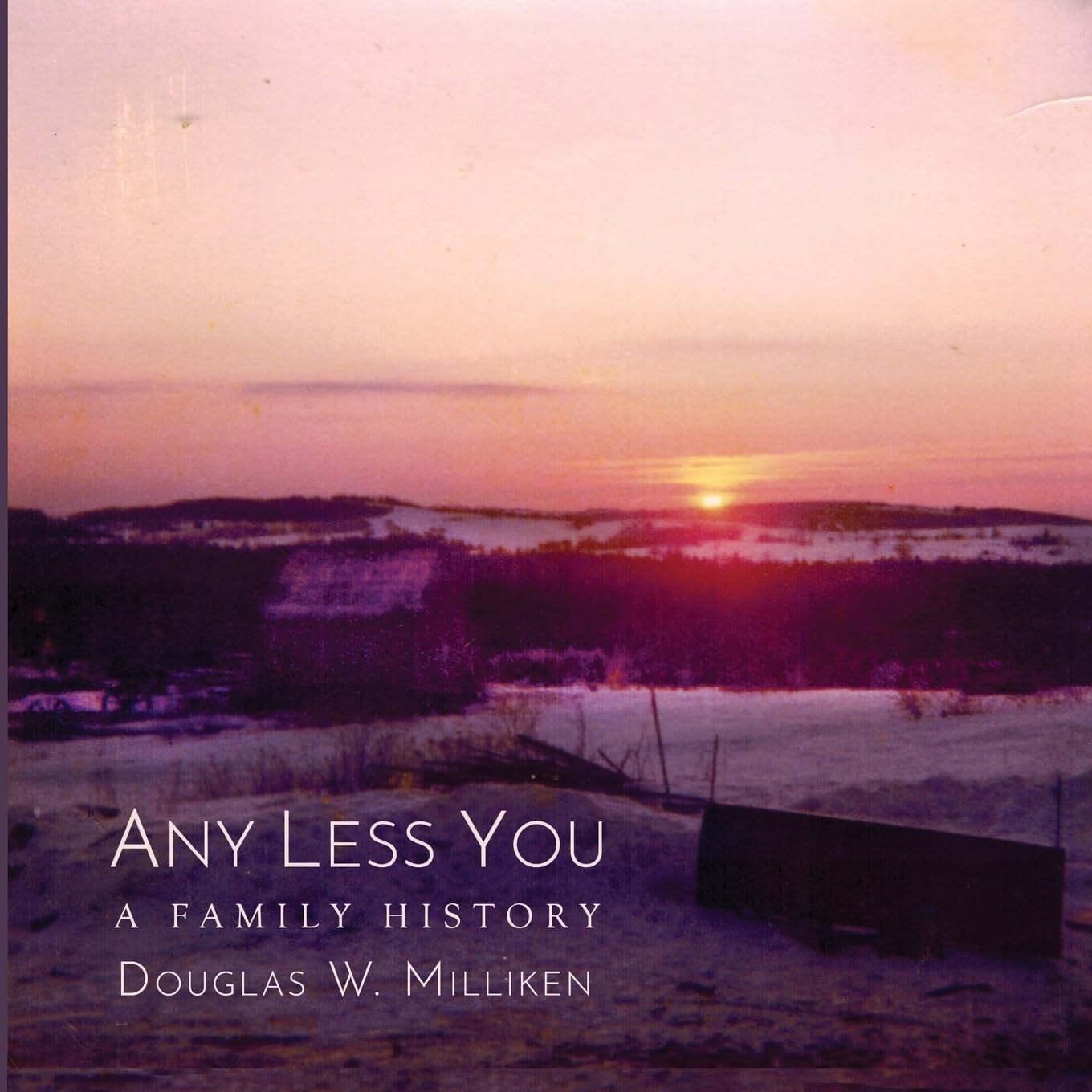
Maine critic and poet Carl Little recently wrote a glowing review of my memoir Any Less You(“a haunting story of broken lives”) for the Working Waterfront, which you can read here.
The kind folks at The Adroit recently published in their fifty-fourth issue my short story “Lucky,” a continuation of my series narrated by the down-and-out former-basketball-champion Coleman.
And the latest installment of The New Farmers Almanac—an infrequent collaborative publication by The Green Horns and Pilot Editions—includes my essay “Landscape (Vertical),” about my years working among the trees at a 150+-year-old apple orchard in Cumberland, Maine. This seventh volume of the series also includes work by former classmate Bridget Huber, longtime collaborator Alexis Iammarino, and my dear friend Jonathan Rodriguez. You can pre-order volume seven of the almanac here.
That’s it for now, y’all. I hope you attend the events you’re available to attend and read the stories that pique your interest. Without your involvement in these things I do, I’d just be an out-of-work weirdo talking to his cats (a lot).
Friday, September 5th, 2025 will mark the release of Ultramarine, a literary/musical collaboration with my chamber group, The Plaster Cramp. Equal parts meditation on the ineffable might of nature and the narrator’s upbringing off the grid, Ultramarine will be available as a 12” vinyl LP (with artwork by Dean C. Thornton) accompanied by a 44-page perfect-bound book containing the titular short story (with interior art by the late Ernest Haskell).
There will be only one pressing of this record. As such, pre-orders need to be in by Friday, July 18th.
For US and International orders, please visit our Bandcamp page.
Thank you so much for listening and for reading. For independent, fringe projects like this, word of mouth is invaluable: please share with anyone who you think might be interested.
Born of a withdrawn mother and an absentee father. Raised in a household of manipulation and hurt. Hearing occasional rumors—of a shovel fight in the front lawn, of a telephone-cord garrote, of violence exacted like the bite of many knives of different sizes—yet knowing nothing, remembering nearly nothing. This is one possible way of describing the early childhood of author Douglas W. Milliken, whose life in writing—from his earliest personal essays to his interwoven short stories to his concise, often brutal novels—has been defined as much by what is missing as what is written. As if the unknowability of his own upbringing set the mold for the perpetual uncertainty central to his fiction.
Yet if you cannot know your origins, how can you possibly know yourself? Collaging memories and research, photographic evidence and interviews both transcribed and reconstructed—soldering together the fragments collected over a lifetime and set against the backdrop of Northern Maine’s austere borderlands—Any Less You is the cumulative struggle of an artist to piece together a fractured whole, a family portrait and a broken mirror, even when what’s revealed might best be left in the dark.
It seems like a sign of liberation—of adulthood’s indefinite postponement—when partisans bomb the university and every student’s personal records, from transcripts to debts, are consumed in erasing fire. If nothing else, it lends Margaux the freedom to continue her preferred art form of list-making unfettered by the authority of academia—until she encounters the breakdowns and disappearances and deaths of the people she admires and cherishes most. A monochromatic painter. A BDSM documentary photographer. A transgendered Aphrodite. A mathematician with an invisible cat. Yet as the concrete details of her world dissolve into the abstraction of loss, they also become more rarefied, more essential. Something small enough to be contained. Small enough to be protected.
Set in a semi-fictional, post-industrial American warzone, this novel explores multiple facets related to the recent nonfictional decades of constant civil unrest, with a particular focus on the complicated nature of holding a personal creative life amid a time of constant violence and change. Despite its heavy themes, the narrative is threaded throughout with veins of absurdist humor that invite and welcome us into the familial warmth of the narrator’s memories of friendship.
Often compared to soundtrack music for films that have never been made, The Plaster Cramp is a cross-genre collaboration I’ve been engaged in for several years with member’s of The b.l.a.c.k. Lodge Brass Band. I typically describe what we do as some form of chamber jazz, but we’re just as much influenced by math rock, folk traditions, and the history of electronic music (from Stockhausen to Regan Farquhar). Which ultimately makes us a pretty strange band. Yet of all the musical projects I’ve attempted throughout my life, this is the first one that strangers seem to actually enjoying listening to. This strikes me as a particular metric for success.
Which is why we’ve decided to attempt an experiment and release our eighth record, Soma, as a limited-edition vinyl LP (our previous recordings were digital-only releases). Alternating between spacious meditations and percussive expeditions, the eleven songs of Soma operate as a non-verbal internal dialogue, improvisations balanced by tight compositions and awash all over with environmental samples of wind and water and laughter. Dean Thornton is currently assembling the artwork, and we’re working with Little Elephant Custom Vinyl, one of the best small-batch record makers in the country. We hope to have records in folks’ hands by October 27th, 2023. In order for that to happen, though, we need to collect pre-orders now.
If this sounds like a fun or enticing prospect, click here to pre-order a copy of Soma by the Plaster Cramp for $40 USD (postage included for US orders). You can also purchase the record through our Bandcamp page (this is especially useful for international orders), or pre-save the songs on the streaming service of your choice (they’ll be added to your library automatically on release day).
Pre-orders need to be made no later than August 22nd, 2023. There will likely not be a second pressing of the record after this date.
A little more info on the composition of Soma:
No poetry.
No abstractions.
I’m tired.
My bones hurt and my head is foggy and this associative chain of memories keeps cycling back to some of the folks who have meant the most to me throughout my life—Joshua, Glen, H., so many others—and to whom I can never speak again, touch again, laugh with or sleep beside again. They are gone, some more mysteriously than others. But I’m still here.
From the very start, death’s sorrowful hand has defined my life (my mother was convinced I was the reincarnation of my brother Daniel: try growing up “normal” with that as the opening lines to your tragic backstory). The way I listen, the stiffness in my gait, how I respond to the sight of something light adrift on a morning thermal: everything about me is somehow informed by loss, and it’s exhausting. I’m tired of the loving part of me being so constantly, irreversibly bound to death. Tired of and tired by. Like a leafless vine fed on sour milk, reaching for something high above, something close to where the light shines through: my roots will never not be sown through the fertile soil, black with worm castings and moldering leaves.
So much for no poetry. Too tired to stick to my own arbitrary rules. Glen would playfully mock me for this. H. wouldn’t give a shit either way. I don’t know how Josh would react because he died when we were still both so young, barely in school: all I really remember is his laughter and his curling locks and how one time we were racing through his grandparents’ kitchen and somehow knocked over an extension ladder (why was there a ladder in the kitchen?), how it came down hard and fast on my bare foot and blackened my big toenail which, in a few days, would terrifyingly fall off. Who else alive knows this story? I’m too tired to answer my own questions.
Somehow, this all equals eleven songs etched in black lacquer. Songs written through the cipher of my worn-down corpus. Songs capturing the listless fatigue stitched through the endless prayer of remembering. Songs embodying an exuberance I wish I could hold and make real. Songs of incidental beauty when I remember not everyone I love is dead. Songs I can write yet only others can perform.
The personnel for Soma are Dead Charlie (reeds, bass recorder, arrangement, contrabass, percussion), Pella (piano, vibraphone, keyboards, arrangement, viola, horns), Ants (horns), Kes (percussion, marimba, kalimba, horns), T (cello, percussion, alto trumpet), and Lawrence (drums, percussion, horns, broken air organ), with me providing composition, arrangement, production, electronics, and keyboards. Field recordings provided by Scott Sell, as well as klankbeeld and Benboncan at freesound.org. All artwork done in collaboration with Dean C. Thornton, who also was indispensable in making all these varied pieces come together as a whole.
As always, thank you so much for reading and for listening. None of these things would be possible without you.
In the usual tidal-bore cycle that dominates my public life as an artist, nearly all of the stories that I published in 2022 were released over just a few weeks in November and December. A few more pieces might actually get published before year’s ends, but now seemed a good time to share the news with interested parties. Which leads us now to this pithy list:
“Cake of the Earth” in Canada’s Hermine, a wonderful journal who just last year published my escape-fantasy “Pop & Freedom.” Told in the voice of one of my favorite recurring characters, “Cake of the Earth”—the first of my pandemic-era writings to be featured in a literary journal—is about as close to a teenage love story as I’ve likely written yet.
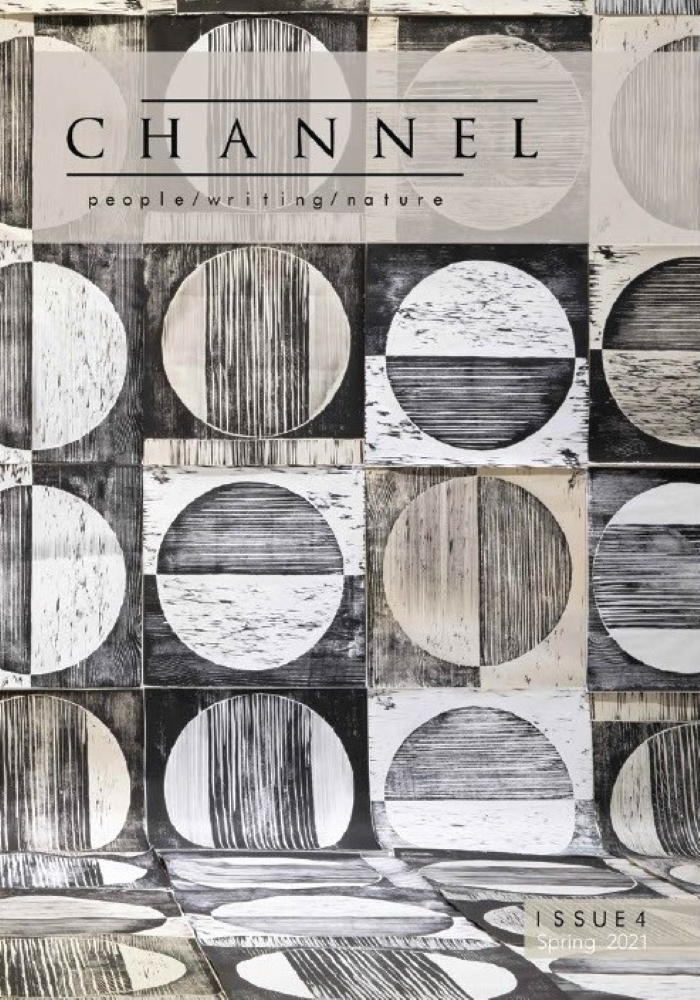
“Robinia” in Ireland’s Channel, a publication focused on nature’s complex relationship with humans. Also a repeat venue for me (they published last year’s “Growth Unencumbered”), the people at Channel have shown me a lot of love and been such great editorial collaborators. This, too, is a pandemic-era story, one wherein I get to exercise a little bit of my own personal fantasizing, about something I should have done but couldn’t do for my mother many years ago.
“Of Age(Caprice)” in Honk Kong’s The Bureau Dispatch. This is a new journal for me, but I really enjoyed working with them to bring this story (and its accompanying dossier) to print. If you can believe it, this one’s actually a Christmas story.
Hermine and Channel are both print journals, so you’ll have to purchase copies in order to read the stories. The Bureau Dispatch, though, is online and free.
In related news, my post-jazz chamber group The Plaster Cramp has a new record out called Wax-Eater. While the album has been available as a digital download from Bandcamp for a couple weeks now, today marks its streaming release on pretty near any platform you can think of (including Spotify, AppleMusic, iTunes, YouTube, and many more). It was a difficult year for me to compose new music—indeed, a difficult year to compose much of anything aside from improvised songs sung at my animal cohabitants, who did not appreciate my efforts one bit—so this record feels especially important to me. I hope you find its range of sounds and textures intriguing.
And that’s it! As always, thank you for reading, thank you for listening, thank you for sharing. None of what I do would mean anything without you.
[For this third episode in the ongoing review/response sequence composed by collaborators and friends, Patrick Kiley takes the time to swim through the emotional and environmental nuances of “Growth Unencumbered,” a short story I wrote while a guest of writer Carl Skoggard and artist Joseph Holtzman at their country home in Valatie, New York. For two weeks in November 2019, I stayed in a refurbished farmhouse on the edge of their property, spending most mornings in the expansive studio addition working on new drafts while periodically looking out the east windows to observe, as the dark slowly eased into dawn, the crepuscular activities of a family of cranky ducks who claimed the nearby pond as their home. (In actual fact, I would never have met Carl and Joe if not for Patrick, who—through his press PS Hudson/Pilot Editions—has published several books by both Carl and me: in a sense, “Growth Unencumbered” very much owes its existence to the ever-reaching connective tissue expanding outward from the kinda-gross-but-ultimately-loving heart of Patrick Kiley.) It was an incredibly important two weeks for me, as an artist and as a human. Partly inspired by S. B. Walker’s Walden series of documentary photographs, “Growth Unencumbered”—originally printed in Issue 4 of the Irish journal The Channel in the spring of 2021—is the first published piece from the body of work I composed while in Valatie. Without the confluence of all these things—the house, the landscape, the photographs, the friendships—I never would have written this story. There’d have been no story to write. — DWM]
Two people go on a walk in some woods to a place that’s special to them. Previously, one of them suffered a wound to his arm which necessitated amputation. Negligence played a role in this accident and left room for shame to creep in. The amputee loves the woman he’s walking with. At the very least, it seems like today things will be okay. But a small, dark revelation bubbles up from the calm of the hampered narrator’s wincing self-reflection. It’s a moment of brutal honesty that, depending on the reader, may provoke a sense of justified revulsion or an irresistible pang of empathy. This is one possible reading of “Growth Unencumbered.”
Reading a story by Douglas W. Milliken is itself like taking a walk—along a shaky ledge above a beautiful coastline. For one thing, you’re often outside in his fiction, and the environment is always sharply drawn. But it’s no postcard. There’s a sense of menace just underfoot. The ground could—and will—give at any moment, but you need to keep walking if you want to see something you haven’t seen before. This is just to say, you never really “settle in” to one of Milliken’s stories—you only ride its edge.
Milliken’s signatures are all over “Growth Unencumbered” almost like olfactory traces: a skunk’s thiol sprayed across a cold boulder last night with a blush of spring violets blown over it this morning. Let me try to bring that home. Mildly rueful self-effacing wisdom and bare honesty that’s so vulnerable it’s almost funny: “I always knew I’d live long enough to see my body fall apart, but still, I never thought I’d see the parts actually shed like leaves from an autumn tree.”
Bitter as almond skin, but who wouldn’t want a nibble?
I’ll admit it: I’m a friend of Doug’s. And when I read his work, even a relatively-short short story like “Growth Unencumbered,” the language in my mind starts sounding like the words on his page. Raw sense saturates common sense. A little sympathetic nimbus grows up and out of my atlas. Every writer casts some kind of shadow with the way they write, and Doug’s sits with me like an alter ego even after I stop reading. This obscure figure starts to direct my attention to little things outside like dead wood and creeping vines, and to the inevitable little battles they’re suffering through in unseen pockets of spacetime. Mice who think they’re people, weeds that have accepted their lot. He also has me look up little known technical names for flora, for tools, for ailments, and for parts of anatomy that don’t stand out as much in their everyday idiom. Milliken’s language is always generous, mixing the profane with the precision-guided. So, for example, the names of human anatomy—humerus, condyle (“an articular prominence of a bone”) are rendered right alongside the imagined parlance of trees: “Wow! Yeah! I’m a tree! Woo-hoo!”.
If I sit back and enjoy the company, I feel like I’m swimming through the story’s as-yet uncomposed penumbral postlude.
Speaking of shadows, does the title itself send a little shiver down your spine, too? No one wants to hear about a growth. What’s this about an encumbrance undone? The words, for me, signal cancer, an uncontrollable proliferation. Milliken’s titles never give too much away and always leave a wide valence for interpretation. I think he wouldn’t be unhappy to know his words gave me pause. Why shouldn’t they?
Another signature of Milliken’s work is the revelation of the past in small details offered well into his stories, like stubbing your toe on a fossilized bone along the ledge you took to be uninhabited. Part way through “Growth Unencumbered,” after easing into the landscape where the story’s main action happens, we’re hit with a tiny declarative paragraph that pierces the veil of a pristine here and now: “That friend’s gone now. So’s his uncle’s house. So’s the magnificent Leonberger. Should anyone be surprised by that?” This is a small, startling crumble in the metaphorical ledge. As the reader proceeds from this moment, more infill from the past gradually pours into the present that we took to be an untouchable immanence, sufficient in itself, all there is. But it’s not. Every body has a phantom limb. As we accompany the characters along their trail we move transcendentally and sometimes painfully through the mystery of their lives, and ours.
Leaves beneath ice after the first snow in Valatie, NY. Photograph by Douglas W. Milliken.
Patrick Kiley is a publisher, writer, father, and make-believe-wooden-dead-guy perpetually haunting the capital region of New York’s Hudson River.
Thus spake Open Mike Eagle in his hurts-so-good anthem “Dark Comedy Late Show,” and man, what a fun line to say aloud and even better sentiment to feel. So while the finishing touches are being applied to the next installment of Friends Saying Nice Things About My Art, here’s a brief intermission to mention that my essay “Anyone Can Have a Good Time” is a finalist for a Maine Literary Award for short nonfiction. The story—an extended meditation on my evolving relationship with my mother before, during, and after her death—was published late last year in Shenandoah, where you can read it for free online along with an accompanying interview.
The Maine Literary Awards are held annually to recognize excellence in the Maine writing community and are conducted by the Maine Writers and Publishers Alliance. Winners will be announced during the award ceremony on May 24th at SPACE in Portland, Maine.