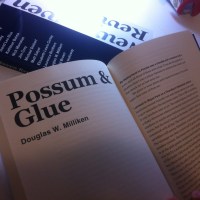
 The New Haven Review, who previously published my story “James Taylor v. the King” (a 2015 Maine Literary Award finalist), included my story “Possum & Glue” in its freshly-minted 18th issue. The story, created as part of Space Gallery’s Goods + Services show, was written for MWPA member Elizabeth De Wolfe. The new issue of the NHR can be ordered here or downloaded as a free PDF here.
Perpetual discomfort & the stigma of disease

Early in September, I had the pleasure of recording a reading and interview with the folks at The Other Stories for their monthly podcast. That episode—featuring my recitation of the story “The Happiest Place on Earth” (originally published in the Word Portland anthology BE WILDER) and our consequent discussion on the story’s genesis and surreal imagery, as well as my constant sense of discomfort in the world—can now be streamed for free from The Other Stories‘ archive. Thank you for listening, and be on the lookout for a resurgence in publishing activity, including new stories in a handful of journals and a brand new chapbook of stories out this coming December (more on that soon).
Stars that shed no light.
A brief recap of the past several weeks’ publications, at home and abroad.
- “Dummy,” another chapter in the on-going narrative of Coleman’s drug-fueled and basketball-informed misadventures, after several years of rejections and near-misses, has at long last found a home in Issue 16 of the UK’s Manchester Review.
- “A Fluent Blue,” written in collaboration with Cat Bates as part of a multimedia art project, has been reprinted in the Island Journal.
- “Pretty,” a micro-addendum of sorts to “Blue of the World,” was an honorable mention in Lindenwood Review‘s annual prose poetry competition and appears in their newly-minted 6th issue.
- “Smoke from a Furnace,” a recently resurrected piece from the past decade, appears in the new “Saints”-themed issue of Canada’s Ricky’s Back Yard, all profits of which will benefit Cancer Research UK.
“Dummy” was written during a fellowship with the I-Park Foundation in December, 2012. “Pretty” was written during a fellowship with the Hewnoaks Artists Colony in July, 2013.
The bird and beetle are gone.
Overwhelming is the only word to describe these past few vernal weeks. A lot of this emotional ride is not worth going into. But maybe this pithy list can sum up what the May of 2016 had in store.
- “Blue of the World”—which won Glimmer Train‘s “Family Matters” contest in 2014 and appeared in their 94th issue —both earned a Maine Literary Award in short fiction, and was selected for the 2017 Pushcart Prize anthology.
- “Hyacinth & Waxwing“—which last year won the Stoneslide Corrective‘s annual short story contest—appears in their newest online issue.
- “Yellow Cake“—a sequel of sorts to last year’s “Toledo“—appears in the newest issue of carte-blanche.
These three bullet points do not even come close to demonstrating the depth and stagger of my joy and gratitude. I love all of these stories. From haunted farmlands to the inscrutable middle of our continent. I’m very proud to have them out there in the world, continuing to have lives beyond my knowledge.
An endless line of identical selves.
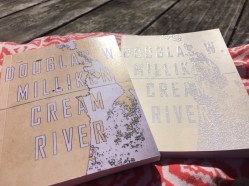
April proved to be a month of repetitions. As noted below, “Preserved“—the documentary essay I wrote as a student at the Salt Institute for Documentary Studies—had a well-received second life in the (figurative) pages of Redux. Meanwhile, while working with my former professor at Salt to edit an even older essay (which will get its ten-year anniversary reprinting in this coming fall’s issue of Fusion), my newest collection of short stories, the pocket-sized edition Cream River, went into its second printing, this time in the able hands of Pilot Editions. And before May coolly ushered itself in, my flash story “Skidder & Draw“—originally published in Portland Monthly—was republished by the consistently supportive editorship of Matter Press. All of which lend to an oddly comforting mindset, to know that these stories continue to live lives of their own, even after I (in at least once particular instance) have forgotten the stories ever existed at all.
All of which makes me wonder: what other stories have I forgotten about, have neglected? What should I double-back to examine again? What deserves a closer look?
What others might see.

Sometimes you work months and years to perfect a story, only to have it published by a magazine or journal that closes up shop within a year of printing your piece. My essay “Preserved” was one such lost story. But thanks to Redux—a journal dedicated to keeping alive stories that have gone out of regular print circulation—my short documentary about heritage and its loss gets a second chance at life.
Preservation can mean finding something precious from someone else’s forgotten life, then saving it forever under glass. It can mean replacing a structure’s every crossbeam and post until nothing original remains but its idea. Preserving can save for some what others might see as a roadblock in the way of progress, and it can also be a way of saving jelly in a jar.
Preservation can mean paying attention to your surroundings.
Preservation can be an act of memory.
“Preserved” originally appeared as “Preservation with Clapboard Gaps” in the final issue of Salt.
The trap of overindulging.
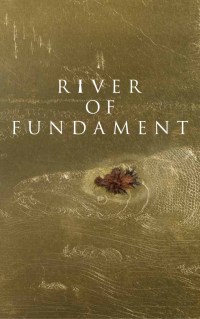 This past February, I had the honor of being invited to a press screening of River of Fundament, the new cinematic opera/operatic film by Matthew Barney and Jonathan Bepler. After the screening—and a couple days to digest the spectacle—I sat down with Jenna Crowder of The Chart to discuss the film. That conversation (edited for coherence) is now available in the March issue of The Chart.
“You become a part of the universe as a whole. So if you’re going to talk about that, you need to acknowledge that sex is a big part of existence. And just the same way that there’s all these different cultures represented, you can’t talk about universal rebirth and only have white guys in America. You miss your own point in doing that. It has to be multicultural. It has to be from the most beautiful compositions and beautiful parts of nature to people covered in shit licking each other’s assholes. You can’t have one without the other.”
River of Fundament will be screening at the Portland Museum of Art, April 1st-3rd.
No amount of desert.
Just maintaining my record of releasing book trailers months and months too late….
One of These Days.
 ONE OF THESE DAYS, the new record by long-inactive art-sound project Old Fat God, is now live and available for streaming, free download, as well as a bundle-purchase with its companion pieces, the story collection CREAM RIVER and the album WHISKEY DICK.
In the introduction to the CREAM RIVER/WHISKEY DICK split, there is a joke about how the sequencing of the book’s stories and the album’s songs might be manipulated in such a way as to achieve a WIZARD OF OZ/DARK SIDE OF THE MOON sort of syncopation. To a degree, ONE OF THESE DAYS takes the joke seriously.
Originally premiering as part of a food-based performance installation curated by Genevieve Johnson at the 2015 Sacred + Profane in Portland, Maine, ONE OF THESE DAYS is an expressionistic reinterpretation of Blind Pelican’s WHISKEY DICK. All verbal elements and instrumentation have been distorted beyond all definitive recognition, reduced to their most rarefied ideals. This is how the songs should feel when you cannot hear the songs.
ONE OF THESE DAYS can be experienced as a stand-alone album. It can also be played in tandem with Blind Pelican’s WHISKEY DICK to achieve an experience unique and separate from either constituent part. It makes a steadfast companion to CREAM RIVER as well.
Hoping for an uncle of her own.
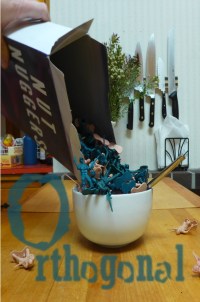 During my last stint at the Hewnoaks Artists Colony, I set for myself the modest challenge of writing a science fiction story. The resultant piece, called “Tootsie-Pop,” is a mythopoeic fiasco of amateur space exploration and foul-mouthed kids, wherein the word “dad” is synonymous with “asshole” and every mom is in love with Uncle Dick. And as of today, you can read this ridiculous misadventure in the debut issue of Orthogonal.
It was the first day of summer vacation and a million people were down by the lake. It was hot and beautiful and such a relief to be away from home and all the damn talk about space stations and dads. The lake water was cold and rusty and made me feel dopey like when the twins and I huffed all that glue out of a sweat sock but cleaner, too, like it was healthy, but Mom wouldn’t come in with me. She was sniffing around by the lifeguard tower, hoping for an uncle of her own, I guess. As I swam among the other people with their wet hair all crazy and spit hanging off their chins, I spotted Ginny along the shoreline in a brown two-piece bathing suit. She had a hula-hoop that she was working quite aggressively with her little round hips, the sight of which for whatever reason made me really mad. She was sucking on a Tootsie-Pop. She was smiling around the stick. Before Mom and I left, I showed Ginny my penis, but she just laughed.
For less than the cost a single beer from anywhere but the divey-est dives, this ebook also features four other great alternative notions of what the sci-fi genre can be. Lovely to savor and just as stupefying. You won’t even have to leave a tip.
 Douglas W. Milliken